 |
Concept Neuro & Spine Care hospital 24 Hour Emergency Facility Available |


Dr. Parimal Tripathi
 |
Dr. Ketan Patel M.S., M.Ch (Neurosurgery) |
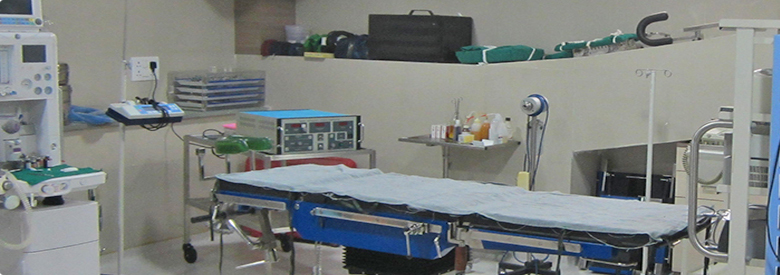
The pituitary gland is a small oval gland at the base of the brain. It controls most of our hormones. These control thyroid activity, the monthly cycle in women, sex drive, growth in children, adrenal gland activity, urine output, the start childbirth and milk-production after pregnancy.
children, adrenal gland activity, urine output, the start childbirth and milk-production after pregnancy.
Treating a pituitary tumor depends on several factors, including:
1. Transnasal Endoscopic Pituitary Surgery
If the pituitary tumor require surgery, typically the best procedure is through a nasal approach. Dr. Tripathi, who specialize in pituitary tumor surgery is expert in the minimally invasive endoscopic traansnasal technique. This procedure removes the tumor while minimizing complications, hospital time and discomfort. This advanced technique requires specialized training and equipment.
Transnasal surgery requires the patient to be under general anesthesia for about 3 hours while the surgeon approaches the tumor through the nasal passage and removes it. In many instances the entire tumor will be removed. In other cases it will be possible to remove most, but not all, of the tumor. There is generally only a small amount of bleeding during the procedure and therefore blood transfusions are rarely required.
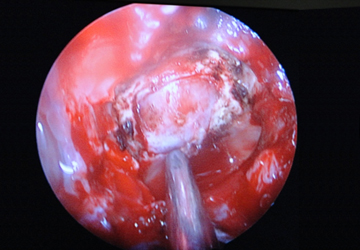
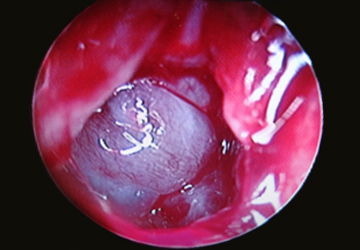
Endoscopic transnasal transsphenoidal surgery (TSS) is a minimally invasive procedure in which the surgeon uses a flexible endoscope to remove the pituitary tumor.
The merits of TSS include the following:
| Pre-operative | Post-operative | |||
|---|---|---|---|---|
 |
 |
|||
| Pre-operative | Post-operative | |||
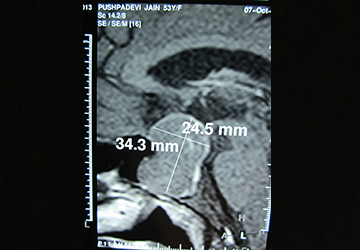 |
 |
|||
| Operative Trans Nasal Endoscopic Picture | ||||
 |
 |
|||
2. Transcranial surgery
Transcranial surgery for pituitary tumors is a surgery to remove a tumor (lump) on the pituitary gland. With a transcranial approach, the doctor will do a craniotomy. A craniotomy is a surgery done to the brain by opening a part of the skull. A portion of the forehead or side of the head may be opened to expose the brain. The doctor after evaluating the patients will decide if transcranial surgery for the pituitary tumour is right for the patient.
For this surgery, the doctor will lift some parts of the brain to get to the pituitary gland. Small, special tools or an endoscope may be used to remove the pituitary tumor. An endoscope is a metal tube with a light and tiny video camera on the end. This gives the doctor a clear view of the brain area while watching the images on a monitor. With transcranial surgery, the pituitary tumor may be removed and symptoms relieved.
Without treatment, a pituitary tumor may grow and push other structures near it. If this happens, there is a danger that the blood or nerve supply may be cut off. One may have problems seeing, breathing, or thinking clearly. This may lead to other serious medical problems, such as blindness or stroke.
 |
 |
|||
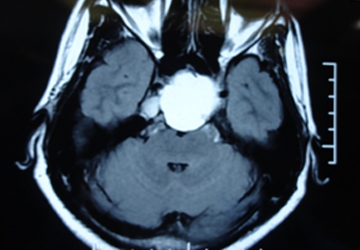
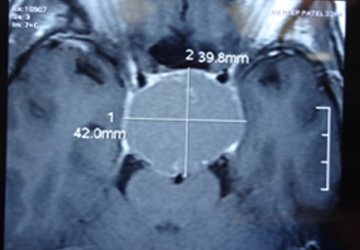
| Pre-operation | ||||
 |
 |
|||
 |
||||